August 25, 2006

Who Was Micajah Clark Dyer?

Photo &copy Billy J. Turnage, Great-great grandson-in-law of M.C. Dyer


Who was Micajah Clark Dyer? Everyone knows the answer to that question, right? While Union County and much of Georgia were recently introduced to the 1800's inventor and aviator, not everyone knows. Thousands of visitors come to Union County each year from across the country and around the world. Would they know who Micajah Clark Dyer was when they drive down the parkway named for him?

Clark's invention came at a time when advancements in aviation had taken a back seat during the Civil War in the 1860's. The economy in the south was still in ruins with reconstruction barely underway when Clark filed for his patent in 1874. His achievement came at a most unexpected time when economic, political and scientific odds were against anyone trying to invent an aircraft in the U.S.

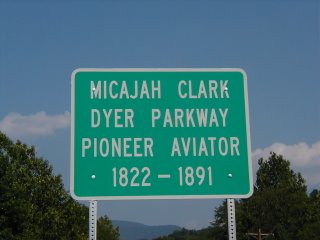
Dyer family members discussed the question of who Clark Dyer is with Rep. Charles Jenkins. Jenkins coordinated the effort to update the Micajah Clark Dyer Parkway signs to include two important aspects about the man the highway was named for. The signs now include two lines that help passersby understand Clark's role in Georgia's, and Union County's, rich history: "Pioneer Aviator" describes Clark's life-work and passion, as well as "1822-1891" delineating his life span.

The family wishes to thank Rep. Jenkins and the Georgia Department of Transportation for their work in updating the signage.

bullet Back to Top      bullet Home

August 17, 2006

Paris proclaimed Sept. 1, 2006
Micajah Clark Dyer Day

Photo: Bonnie Jenkins, wife of Rep. Charles Jenkins (D)


As reported by the North Georgia News, August 23, 2006 covering the monthly County Meeting by Janice Boling
bullet To view the source site for this and more news articles on Micajah Clark Dyer, click here.

The story of Micajah Clark Dyer and his inventions, particularly his flying machine, is an amazing one that was kept alive through Dyer family oral tradition until 2004 when, thanks to the modern invention of the internet, family members were able to identify the 1874 patent and obtain a copy, proof that the machine had, in fact, been built and that sophisticated plans had been filed with the United States Patent Office," said Paris. "I am very pleased to proclaim September 1, 2006 as Micajah Clark Dyer Day. September 1, 1874 is the date Mr. Dyer received a patent for his flying machine."

Paris offered a special thanks to the family and friends for "their stick-to-it-ness in finding the proof, bringing it to the consciousness of the public, having State Representative Charles Jenkins and Georgia Department of Transportation dedicate the portion of Hwy. 180 that Micajah probably traveled, and in hopefully giving Union County a place in the history books for future generations to know and appreciate."

bullet Back to Top      bullet Home

August 12, 2006

Aviator flies to fame

As reported by The Times, August 12, 2006 Front Page Local News by Rick Lavender
bullet To view the source site for this and more news articles on Micajah Clark Dyer, click here.

Micajah Clark Dyer Jr. may land in the Georgia Aviation Hall of Fame, whether he flew or not.

Howard "Mac" McWhorter, chairman emeritus for the aviation hall's board of directors, said this week the Union County settler has drawn attention for his 1874 patent on a "flying ship."

The hall is interested in adding Dyer, his invention and his quest in a timeline of state aviation history, particularly considering that Georgia's flight centennial is next year.

It's not yet clear exactly how Dyer will be featured in the hall, which is part of the Museum of Aviation at Robins Air Force Base in Warner Robins.

"What we do with it, I don't know yet," McWhorter said.

Dyer descendant Sylvia Dyer Turnage had known of the interest.

"I'm very, very pleased," said Turnage, who lives on her great-great-grandfather's farm in the Choestoe community.

Dyer received a patent for a craft with a zeppelin-shaped balloon and hinged, bird-like wings nearly 30 years before Orville and Wilbur Wright recorded the first sustained, powered flight of a controllable heavier-than-air aircraft.

According to family members, eyewitnesses said Dyer also flew some version of this craft or another off Rattlesnake Mountain at his farm. The story continues that his wife sold the invention to two Redwine brothers after Dyer's death in 1891, and they possibly resold it to the Wright brothers.

There are questions about whether Dyer ever made it off the ground. At least one aviation history specialist also has looked askance at any connection with the Wrights.

But McWhorter said the hall is looking into the different angles.

Events and possible exhibits also are being mapped out to recognize 100 years of Georgia aviation. Ben Epps logged the state's first airplane flight in field near Athens in 1907. Dyer could crop up in related exhibits, or celebrations inducting four hall members next April in Warner Robins and marking Epps' flight in October 2007 in Athens.

The state recently renamed part of Ga. 180 that leads through Choestoe as Micajah Clark Dyer Parkway.

Turnage said that Union's sole commissioner, Lamar Paris, also plans to proclaim Sept. 1, the date Dyer received his patent 132 years ago, as Micajah Clark Dyer Jr. Day in the county.

Contact: rlavender@gainesvilletimes.com, (770) 718-3411.


bullet Back to Top      bullet Home

August 6, 2006

One man's 'Apparatus for navigating the air'

photo Tom Reed, The Times


As reported by the Gainesville Times, Rick Lavender
Local News, August 06, 2006
bullet To view the source site for this and more news articles on Micajah Clark Dyer, click here.

No one knows what convinced Micajah Clark Dyer Jr. he could fly more than a century ago. But many descendants of this Union County mountain man are convinced he did. In a boat-like craft built before "airplane" was a word and years before the Wright brothers cleared a beach on North Carolina's Outer Banks.

The Dyer legend even made it to a road sign last month. State Rep. Charles Jenkins, D-Blairsville, sponsored a bill naming a stretch of Ga. 180 near Blairsville as Micajah Clark Dyer Parkway.

"I think there's a lot of credibility to the story," Jenkins said.

Others will disagree. In the southern Union community of Choestoe, however, the 19th century "dirt" farmer some regard as a genius is a heavy favorite.

Sylvia Dyer Turnage, a great-great-granddaughter, and her husband own what was Dyer's farm at the foot of Rattlesnake Mountain. Dyer supposedly skidded down the steep mountainside on slicked wooden rails to take off.

Turnage recently showed two small models of his craft, made by a family member. Plastic green Army men filled in as pilots.

The account of at least one eyewitness, who has since died, and others passing along stories told as true about her great-great grandfather are reputable, Turnage said.

"That's why this story has stayed alive."

Ga. 180 leaves U.S. 129 north of Neel's Gap and south of Blairsville, crosses the Nottely River, and whips past pastures and creeks flanked by rumpled mountains. The Appalachian Trail treads these highlands. Brasstown Bald, Georgia's tallest peak, is a short drive up the two-lane highway.

Dyer's mother, Sallie Dyer, moved here with her son and parents from South Carolina in 1833. Micajah Clark Dyer Jr., born on July 23, 1822, was no older than 11. He may have been illegitimate, according to family researcher Ken Akins, noting that the boy's father didn't make the move and the child took the name of an uncle, Micajah Clark Dyer Sr.

Sallie remarried. But her son, called Clark to distinguish him from his uncle, was raised by his grandfather, according to a booklet Turnage wrote.

The new start in the Choestoe district came in a new county. Union had been carved in 1832 from Cherokee Indian territory. Choestoe is Cherokee for "Land of the Dancing Rabbit."

But life was no dance here. The mountains region was rugged and remote. Farmers scrounged a living in the valleys. Town meant Blairsville, the county seat incorporated in 1847.

Self-reliance was crucial. Neighbors could be scarce. As of 1848, Union's population numbered only about 5,800.

By then, Micajah Clark Dyer Jr. had married and fathered two children, with seven more to come. He also had begun studying the flight of buzzards and birds of prey, pondering a mystery that would fascinate him for life:

How to fly.

The Gainesville Eagle announced in July 1875 that Dyer had received a patent for a "flying ship."

The short account went on to describe the craft and highlight the inventor's confidence that he had "solved the knotty problem of air navigation." But the article also said Dyer had studied the subject for 30 years and tried other experiments, all of them failed until now.

That work resulted in stories passed down for generations, settling into local lore like morning mist along a mountain stream.

Twenty years ago, Akins, Turnage's nephew, and a fellow college student began backtracking on the stories. Their work and that of others, including Turnage, reveal a relative out of kilter with any picture of a backwoods pioneer.

Akins said Dyer, of whom no photograph exists, had piped water to his log home at the head of Rough and Stink creeks. The gravity-fed system, a first for indoors plumbing in Union County, ran from a reservoir on the hillside above the home. Dyer later switched from hollowed-out logs to iron pipes.

Family members now dead also recalled a home with the logs hewn to a precise fit, a yard strewn with "gadgets and stuff," as Akins said, and a back workshop closed to all but a few and whispered about by neighbors.

In the workshop, Dyer supposedly created a perpetual motion machine, a Holy Grail for 19th century inventors. He even sent a model of it to Washington, D.C. According to family, his son Mancil inexplicably turned down a $30,000 offer for the invention after his father's death.

But Dyer was working on something else behind closed doors. A flying ship.

"The neighbors thought he was loco," Turnage said. "They couldn't understand why anybody at that time would spend such time on such a wild idea."

Dyer wasn't alone. The quest to create flying machines was growing worldwide.

An online database lists pages of U.S. patents involving aviation from 1799 through 1909. The age-old desire to fly was shifting from balloon flights in the 1780s to the concept in the 1800s of a heavier-than-air, fixed-wing craft with a propulsion system and movable surfaces for control.

Peter Jakab, aeronautics division chairman at the Smithsonian Institution's National Air and Space Museum in Washington, D.C., said that by the 1870s, "Serious, established engineers ... were starting to take aeronautical investigation seriously."

That interest helped spur research papers, presentations and data sharing, building a mountain of trial, error and evidence that Wilbur and Orville Wright later used.

In addition to their creativity and organization, the Ohio brothers examined what others were doing.

"They had a great ability to assess the positive and dead-end patterns," Jakab said.

They also recognized that an airplane is a system of inventions, all vital, he said.

The Wrights are credited with building the first fully controllable glider in 1902. After adding a gas engine and propellers, Orville Wright recorded what is widely considered the first sustained, powered flight in a controllable heavier-than-air aircraft on Dec. 17, 1903, at Kitty Hawk, N.C.

Dyer had followed a different design to reach a similar end decades before, according to family.

Some who knew Dyer said he first built a scale model of the craft, adding a propeller turned by a clock spring. The model flew, they said.

Some people interviewed by Akins and Bob Davis also said the same of the larger aircraft.

Akins, now managing director at the state's Etowah Indian Mounds Historic Site in Cartersville, remembered talking with Johnny Wimpey, Dyer's grandson.

Wimpey, of Blairsville, was 8 when his grandfather died. He was nearing 100 and in frail health when Akins interviewed him.

Wimpey was sitting on a couch, his face blank, until Akins mentioned Dyer's flying machine.

"It was like he came to life," Akins said.

As a boy, Wimpey had helped Dyer build a rock wall, and Dyer often had allowed him into his workshed. Wimpey said he had seen the flying machine. He had even seen it in the air.

Dyer reportedly built rails up the side of Rattlesnake Mountain. He then slid the craft down them, picking up speed to take off into a cornfield just across Stink Creek.

"He said he actually flew it up that valley," Akins said.

Up, and back and forth, he said.

When Akins went to leave that day, Wimpey exclaimed, "I'm telling you the truth!"

"He kept saying that as I went out the door," Akins said.

Wimpey's account, the tales of others about Dyer's flights and the consistency of the stories made a believer out of Akins.

Yet, until about two years ago there was only anecdotal evidence.

Dyer had supposedly applied for a patent. But none could find it.

Then a younger relative tried the Internet search engine Google in 2004, an unimaginable option when Akins and Dyer were scouring paper records in the 1980s. A link to the patent popped up.

Turnage heard about the find during church. She hurried home after the service and typed in a few key words.

"I saw the patent," she said. "All my life, I'd heard about the patent."

Patent No. 154,654, applied for in June 1874 and approved that Sept. 1, describes in technical writing and sketches Dyer's "Apparatus for Navigating the Air."

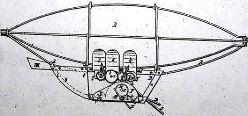
The so-called flying ship looks like a small boat under a tube-shaped balloon. There are three flap-like wings on each side. Dyer wrote that the craft can be run by steam or other power, in this case paddle wheels.

According to the 1875 Gainesville Eagle account, which was reprinted in the St. Louis Globe-Democrat and at least one other newspaper, the balloon lifted the ship. Dyer's patent description says the covering could be made off any strong, lightweight material that was waterproof and airproof. Akins said some suggested he used boiled corn husks.

The wings, or flaps, worked up and down together or individually, and could be angled for altitude, according to Dyer.

A rudder helped steer the creation.

The details and scope seem startling for a man who may never have gone to school or read much more than the family Bible. He certainly wasn't privy to the aviation schemes circulating in engineering circles.

"The drawing is so precise," said Jenkins, an aerospace retiree from the former Lockheed Corp., "I would say somebody from Georgia Tech couldn't do better."

The details didn't necessarily fit popular ideas of what Dyer might have made. Those leaned toward a fixed-wing craft.

But the patent did match stories told by those who knew him or his children. Accounts including pedals and a body built of white pine.

The patent also helped lead to the road-name change, celebrated in a May 31 signing with Gov. Sonny Perdue at the Capitol and a July 15 dedication coinciding with a family reunion at Choestoe Baptist Church.

Turnage acknowledges that she has been captivated by the stories for years. She even wrote a poem, since put to music, telling of Dyer's invention rising from the earth, "a sight to behold indeed."

It also is hard to find longtime residents in Choestoe who don't know the story and don't have some tie to the Dyer family. Most believe that Micajah Clark Dyer Jr. actually flew.

Roma Sue Turner Collins said her grandmother, a Dyer, saw the craft airborne.

"I would just put my life on it that it's a true story," Collins said recently.

Jakab might disagree. The aviation expert from the Air and Space Museum saw only a rough sketch of the invention this week. By those dimensions, which roughly mirror the drawings in the patent, he said the balloon does not appear large enough to lift the craft.

The flappers, as opposed to fixed wings, also were "one of the great barriers" to advancements in flight, because the physics don't work for heavier-than-air aircraft, Jakab said.

Dyer's design appears instead more in the line of a lighter-than-air craft, because it apparently depends on a balloon to stay aloft, and possibly as a dirigible or steerable balloon.

Whether that stance will float with Dyer descendants is questionable. But there's another pressing question: What happened to the invention?

Dyer died at age 68 in the winter of 1891. He continued to work on his airship until his death. The Gainesville Eagle story suggests that as of 1875 he had not built the patented version of it. But he planned to, and according to the family's research, did.

After Dyer's death, the word is that his widow, Morena, sold the aircraft to two Redwine brothers from Atlanta or Gainesville. Akins writes that she may have needed the money.

The tale then is that the Redwines possibly sold the craft to the Wright brothers.

The latter connection is open to speculation. The Wrights, said Jakab, seem to turn up rightly or not in almost every story involving the history of early flight.

But believers in Dyer's accomplishments will continue to dig. The family is hoping someone will build a full-scale version following the patent. There also is talk of including Dyer in a 2007 exhibit at the Museum of Aviation at Robins Air Force Base in Warner Robins.

Turnage recently walked visitors past Stink Creek, where Dyer had a grist mill, and into what is now a hayfield where, as the story goes, he took to the air. Turnage's home is near where Dyer's once stood, overlooking the field.

On this hazy summer day, a plane buzzed high over the green mountains. Turnage said someone once commented, "We flew over your place,"

"I told him, 'Don't you think you're the first guy to do it.'"

She hopes to one day learn what happened to her great-great-grandfather's aircraft, and whether there's any truth to the Wright brothers story. But Turnage, like Akins, considers one mystery settled.

Asked if she has any doubts that Dyer flew, she answered smiling but firmly, "Oh, no."

Contact: rlavender@gainesvilletimes.com, (770) 718-3411.

bullet Back to Top      bullet Home

Blairsville family reflects on ancestor's legend of flight

As reported by the Associated Press syndicated from the article by Rick Lavender in the Gainesville Times, Front Page Local News, August 06, 2006
bullet To view the source site for this and more news articles on Micajah Clark Dyer, click here.

GAINESVILLE, Ga. (AP), August 06, 2006-- On a hazy summer day, a plane buzzed high over the green mountains in Union County.

Someone once told Sylvia Dyer Turnage, "We flew over your place."

Her comment: "Don't think you're the first guy to do it."

That's because she and other family members are convinced that her great-great-grandfather, Union County mountain man Micajah Clark Dyer Jr. created a machine that carried him in the air, years before the Wright brothers lifted off the beaches of North Carolina.

No one knows what convinced Dyer to embark on a quest to fly. But for decades, his descendants have been on their own quest - to find out what he knew about aviation - and what he did.

"I would just put my life on it that it's a true story," said Roma Sue Turner Collins, who said her grandmother, a Dyer, saw the craft airborne.

Dyer's flying machine looked more like a boat carried by a balloon and the 19th-century inventor reportedly built rails up the side of Rattlesnake Mountain then slid the craft down the mountain, gathering speed to take off into a cornfield across a nearby creek.

Family members are hoping someone eventually will build a full-scale version of his machine, listed as Patent No. 54,654 as his "Apparatus for Navigating the Air." There is talk of including his work in a 2007 exhibit at the Museum of Aviation at Robins Air Force Base in Warner Robins.

The legend even prompted State Rep. Charles Jenkins, D-Blairsville, to sponsor a bill naming a stretch of Georgia 180 near Blairsville as Micajah Clark Dyer Parkway. The road's name was changed after a May 31 signing by Gov. Sonny Perdue at the state Capitol.

"I think there's a lot of credibility to the story," Jenkins said.

Dyer's design looks like a small boat under a tube-shaped balloon. There are three flap-like wings on each side. Dyer wrote the craft can be run by steam or other power, in this case, paddle wheels.

He was the subject of an article in The Gainesville Eagle in July 1875, months before his patent was approved.

The short newspaper account described the craft and noted the farmer's confidence that he had "solved the knotty problem of air navigation."

It also noted that he'd studied the problem for 30 years and tried and failed.

Until he came up with the design of the flying ship in the patent.

Dyer wasn't your typical "dirt" farmer of the area. When family members a few decades ago began backtracking the stories about him, they found he created a gravity-fed system to pipe water to his log home, likely the county's first indoor plumbing.

Other family members recalled the logs in his cabin were hewn to a precise fit and his yard was strewn with gadgets.

All this from a man who might not have gone to school or even read more than the family Bible.

But it was his entire life's pursuit of flight until he died in 1891 at age 68 that baffled his peers.

"The neighbors thought he was loco," said Turnage. "They couldn't understand why anybody at that time would spend such time on a wild idea."

But worldwide, the quest to create the flying machine was growing. Pages of U.S. patents involving aviation from 1799 through 1909 fill an online database. Dreams of flight were shifting from balloon flights in the 1780s to the 19th-century concept of heavier-than-air, fixed-wing craft containing a propulsion system and moveable surfaces for control.

"Serious, established engineers ... were starting to take aeronautical investigation seriously," said Peter Jakab, aeronautics division chairman at the Smithsonian Institution's National Air and Space Museum in Washington.

The Wright brothers are credited with building the first fully controllable glider in 1902 and after adding a gas engine and propellers, Orville Wright recorded what's widely considered the first sustained, powered flight in a controllable heavier-than-air aircraft on Dec. 17, 1903 at Kitty Hawk, N.C.

But Dyer family members believe Dyer followed a different design to reach a similar end, but decades before Wright's flight. They believe Dyer flew after adding a propeller turned by a clock spring to a scale model of his craft.

Jakab said the balloon in Dyer's design does not appear to be large enough to lift the craft and the flappers, as opposed to fixed wings, were "one of the great barriers" to advancements in flight, because the physics don't work for heavier-than-air aircraft.

Although experts continue to wonder about Dyer's flying machine, Turnage does not. She considers that mystery settled.

Asked if she doubts that Dyer flew, she said, smiling but firmly, "Oh, no."

---

Information from: The Times, http://www.gainesvilletimes.com

bullet Back to Top      bullet Home

July 20, 2006

Post-reunion reflections

As reported by the Union Sentinel July 20, 2006 by Ethelene Dyer Jones
bullet To view the source site for this and more news articles on Micajah Clark Dyer, click here.

Last week's column looked forward to the Dyer-Souther Heritage Association annual reunion held on Saturday, July 15, 2006. We anticipate it each year with great joy, knowing that we will meet more kin that hear about it and make their way to the gathering. Like children looking for Christmas, we think it will never come. Then the big day arrives, we enjoy it tremendously and it is too soon gone.

I don't want to belabor the point, but this year's reunion may have been one of our best. Registration showed 214 in attendance for the morning, noon and early afternoon gathering. Many more came for the program at 3:00 p. m. commemorating the invention of Micajah Clark Dyer's "Apparatus for Navigating the Air," and the naming of a portion of Georgia Highway 180 the Micajah Clark Dyer Parkway. The new arrivals lifted the attendance count to 300 or more. That program itself, carefully planned by Clark Dyer's great, great granddaughter, Sylvia Dyer Turnage, was well worth the effort people made to come from great distances, such as California, Oregon, Ohio and Texas to attend the dedication service. Sylvia and her family worked on wonderful displays that told the story of the inventor and his patent for the "Apparatus..." secured in 1874. The displays were given to the Union County Heritage Association Museum where visitors may read and see the story of Micajah Clark Dyer.

Earlier, in the regular reunion part of the program, a spinning wheel was donated to the Union County Historical Society Museum. Made by John Combs Hayes Souther in 1875 when his daughter, Sarah Evaline married Bluford Elisha Dyer, the heritage piece had been lovingly cared for and preserved by Ann and her husband,

the late Bill Rich, and had come to them by Bill's mother, the late Nancy Louisa Dyer Rich, a daughter of Sarah Evaline and Bluford Elisha Dyer.

Many attended for the first time this year. Among them were Ralph Collins of Granbury, Texas, who is a great, great grandson of Willliam Dallas Collins (18461938) and Sarah Rosannah Souther Collins (1849-1929). Several months ago Ralph Colllins (who has the nickname "Bits" because he was called "Little Bit" as a child) called and introduced himself to me. He had visited my cousin William Clyde Collins of Choestoe and Clyde gave "Bits" my telephone number, telling him I was historian of the Dyer-Souther Heritage Association.

Already, Ralph Collins had learned that his great, great grandfather, Dallas Collins, was the third child and first son of Francis ("Frank") Collins (1816-1864) and Rutha Nix Collins (1822-1893), and Francis was the fourth child of first Collins settlers to

Choestoe, Thompson Collins (1785-1858) and Celia Self Collins (1787-1880).

Ralph Collins' great grandfather was the firstborn of Dallas and Rosannah Souther Collins, James Elias ("Eli") Collins and Frankie Jane Jackson Collins (1870-1962). His grandfather was Vance Porter Collins (1897) who was born in Georgia before his father, James Elias, moved to Granbury, Texas. In Texas, Vance Porter Collins married Jessie Linthicum, and their second child, Doyle Collins, became Ralph "Bits" Collins's father.

Ralph and I have been exchanging e-mails and family history information. He and I agree that once one becomes interested in genealogy, it is hard to let go until the missing pieces of the puzzle of family connections are fitted together.

Have you ever met anyone whom you felt, at first contact, that you have known all your life? This was the case when Bits Collins and I first met in person on Sunday, July 15 at the reunion. Cousins whose

common ties reach for generations back are inextricably tied together by common family bonds and hardy pioneer stock. His great grandfather "went west" looking for a better way of life, leaving behind the graves of two babies who died as infants, Rannel Collins (1891) and Floyd Collins (1897), buried in the Old Choestoe Cemetery. Without access to any James Elias Collins family journals, we can assume that he and his wife Frankie Jane Jackson Collins moved to Granbury (or Weatherford), Texas about 1902 with their children Leona, Arthur, Vance Porter, Ernest Fulton, and Marion Dallas (born in Georgia in 1901). The last four children of James Elias and Frankie Jane Collins were born in Texas: Tressie (1903), Joseph Taylor (1905), Gusta Roseanne (1909) and Vester Eugene (1912).

I was a child when my great Uncle Dallas Collins died October 18, 1938. His funeral made a lasting impression on me. My mother and father took me to Uncle Dallas' home

near New Liberty Baptist Church where they helped with funeral preparations. My father, Jewel Marion Dyer, was handy with tools and he helped to make the casket for Uncle Dallas from seasoned timbers stored in the barn for that purpose. Great Aunt Sarah Rosannah Souther Colllins (1846-1929) had preceded her husband, Great Uncle Dallas, in death. She was my father's great aunt (a daughter of Jesse John and Mary "Polly" Combs Hayes Souther). Her husband, Dallas Collins, was my mother's uncle. This double-relationship was somewhat hard to figure out. We just knew we were "kin" on both sides of the family. I can remember the ladies preparing the body for burial. They also lined the casket with cotton and attached a satiny cloth to its interior before the body was gingerly laid in the homemade coffin. That was in the days before country folks used funeral homes. Mother and other kin also helped her cousin Martha Aria Collins with the cooking for the large crowd that gathered for

the funeral. Aria and her husband, Moody Watson Collins, lived with and looked after Uncle Dallas prior to his death. The funeral was held at the house the next day, with a large crowd present.

I told Ralph "Bits" Collins this remembrance from my childhood of his great, great grandfather's funeral. Sadly, Ralph's great grandfather, James Elias (Eli) Collins did not attend the funeral. This firstborn son of William Dallas Collins preceded his father in death, dying in Granbury, Texas on January 8, 1938.

Back in Milledgeville, Georgia, which is now my dwelling place, I am still reveling in the memories of a marvelous day in the hills of Union County, where the morning mists covered the mountains with an effervescent glow as the sun rose to drive the fog away and provide a marvelous day of beauty. The fellowship, as well, was bright and shining. Selah.

(Those wishing to get in touch with Ethelene Dyer Jones may call her at 478-453-8751 or e-mail her at edj0513@alltel.net).

bullet Back to Top      bullet Home

July 17, 2006

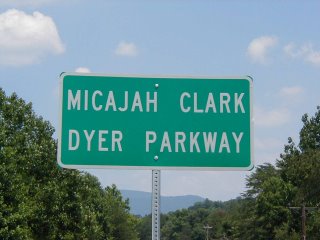
Micajah Clark Dyer Parkway - Signs placed

Micajah Clark Dyer Parkway sign


The Georgia Department of Transportation unveiled the new Micajah Clark Dyer Parkway signs posted on Georgia Highway 180 from the intersection at U.S. Highway 129 to Georgia Highway 180 Spur at the Towns County line. By early this morning, the sign used at the official ceremony at Choestoe Baptist Church was placed at the intersection of Georgia Highway 180 at Georgia Highway 348, the "Richard B. Russell Scenic Highway."

The picture above looks east up Highway 180 towards Choestoe community and Brasstown Bald, the area Clark invented his "apparatus for navigating the air."

bullet Back to Top      bullet Home

July 15, 2006

Relatives honor 'a genius'

As reported front page by the Union Sentinel
July 20, 2006 front page by Joan Crothers.
bullet To view the source site for this and more news articles on Micajah Clark Dyer, click here.

Micajah Clark Dyer was finally getting the due he deserved as relatives and friends gathered at the Choestoe Baptist Church on Saturday, July 15. The beautiful Fellowship Hall was filled to capacity with an estimated 300 people, most of them related to some part of the Dyer family.

Clark Dyer, as the family refers to him, is credited with creating and setting to flight a "flying machine" off of Rattlesnake Mountain in Choestoe, Union County, sometime in the 1870s. His patent has also been found and one person, Johnny Wimpy, now deceased, was 8 years old when "he saw it fly." He had also also helped Dyer build a large rock wall that is still standing. Dyer is also credited with creating a system of logs to pipe running water to his house from a spring. Neighbors saw him work on other inventions, but most ridiculed him for wasting his time on a flying machine, so he kept it quite secret.

However, when he did get a patent for his invention in 1874, he put an article in the St. Louis Globe of July 1875 and the Gainesville Eagle, some now thinking he was trying to get funds to build his flying machine. After he died in 1891 at 69, his wife sold his plans and machine to brothers named Redwine and they reportedly sold them to the Wright brothers.

Sylvia Dyer Turnage was the organizer of this recognition of her great, great grandfather and thanked her family for all their support and help. She said she first read about the flying machine in a family history book, but it was 25 years later when the 1874 patent for the flying machine was found through the internet.

Turnage turned a poem she had written about this unusual man into a song, which she sang accompanied by Sam Ensley on the guitar.

The highlight of the event was the unveiling of a road sign, one of three, dedicating part of 180 to Micajah Clark Dyer. This came about through efforts of Rep. Charles Jenkins in having the Georgia Legislature approve a proclamation honoring Dyer.

bullet Back to Top      bullet Home

July 4, 2006

Highway Name to Honor 1874 Flying Machine Inventor Micajah Clark Dyer

copyright 2006 Micajah Clark Dyer's Apparatus for Navigating the Air


There will be a dedication service for the naming of Micajah Clark Dyer Parkway on Saturday, July 15, 2006 at 3:00 p.m. at the Choestoe Baptist Church Family Life Center south of Blairsville, Georgia. The Parkway is being named to honor Mr. Dyer for his invention of a flying machine, for which he was granted a United States Patent in 1874. The portion of Georgia Highway 180 to be named is from the junction of the Gainesville Highway (U.S. 19 & U.S. 129) to the Georgia Highway 180 Spur which goes to Brasstown Bald Mountain at the Union and Towns County line. The public is cordially invited to attend.

bullet Back to Top      bullet Home

May 31, 2006

Georgia Governor Sonny Perdue Honors Micajah Clark Dyer at Capitol


As reported front page by the Union Sentinel, June 15, 2006:
bullet To view the source site for this and more news articles on Micajah Clark Dyer, click here.

A group of Dyers from Georgia, Alabama and Florida journeyed to the Capitol on May 31 to meet with Governor Sonny Perdue for official recognition of their ancestor, Micajah Clark Dyer, who invented a "flying machine" in the North Georgia mountains more than two decades before the Wright brothers' flight at Kitty Hawk, N.C., in 1903.

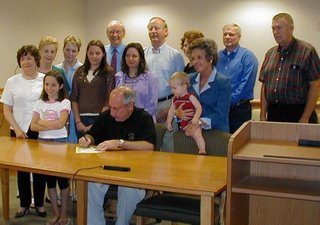
The Governor signed H.R. 413, which incorporated H.R. 1236 introduced by Rep. Charles Jenkins and approved by the Legislature during its recent session, to name a portion of State Hwy. 180, located about 8 miles south of Blairsville, Ga., the Micajah Clark Dyer Parkway.

The youngest descendent present at the Governor's office was 10-month-old James Micajah Cooper, a great-great-greatgreat grandson of the inventor (pictured above). His parents are Joseph and Sarah Coker Cooper, and his grandparents are David and Geraldine Dyer Coker.

Although the U.S. Patent Office granted Dyer a patent for his machine on September 1, 1874, it was only a little over a year ago that the family finally located the patent and authenticated the legend that has been handed down through generations about the airplane Dyer invented and flew off Rattlesnake Mountain in Union County.


According to oral history, after Dyer's death in 1891 his widow sold the plans and specifications for the aircraft to two Redwine brothers in Atlanta, who later sold them to Orville and Wilbur Wright. It is probable that the Wrights incorporated Dyer's design into their plane and received credit for the first flight.

Following discovery of Dyer's patent, word has spread about his sophisticated drawings and descriptions crafted at this early time in history and his important contribution to the advancement of aviation. The Curator of the Georgia Aviation Hall of Fame at the Museum of Aviation located at the Air Force Base in Warner Robins, Ga., is planning to include Micajah Clark Dyer in the celebration of Georgia's 100th Anniversary of Flying planned for next April.

A dedication ceremony for the Micajah Clark Dyer Parkway is planned for Saturday, July 15, 2006, at 3 p.m. at the Choestoe Baptist Church Life Center, located on Highway 180 a short distance from US Hwy. 19/129, south of Blairsville. The Dyer family is cordially inviting everyone to attend the celebration.

bullet Back to Top      bullet Home

May 18, 2006

Highlights of Aviation History

As reported by the Union Sentinel, August 06, 2006
Front Page by Ethelene Dyer Jones
bullet To view the source site for this and more news articles on Micajah Clark Dyer, click here.

Thanks to Union County Representative, the Honorable Charles F. Jenkins, Highway 180 will soon be designated the Micajah Clark Dyer Parkway.

The resolution which has passed the Georgia House and Senate will receive Governor Sonny Perdue’s signature at a ceremony at the state capitol on May 31. Some of the descendants of the Choestoe inventor will be present for the significant signing.

In this column several months ago, you read how the patent for “An Apparatus for Navigating the Air” was registered with the U. S. Patent Office in 1875. In his workshop near Rattlesnake Mountain at Pine Top in Choestoe District, this farmer-turned-inventor labored away to perfect his flying machine. My Uncle Herschel Dyer told of seeing the machine and so did a grandson of Micajah Clark Dyer, John Wimpey.

His plans for the apparatus were drawn to scale and his description of how to build the machine read like those of a well-educated engineer. For years “Clark Dyer and His Flying Machine” were treated like legend, a story passed from generation to generation for the purpose of claiming some glory from one who had gone before. It has been said that this genius of the mountains secluded himself to work as much as possible on his plans for an airplane. As a recluse, he was considered somewhat eccentric and “different” from his neighbors.

He lived from 1822 through 1891, and got his airship to lift from a take-off runway he had built on the mountain, aiming the vehicle to his cleared field. He died before he had perfected the flying machine. His plans were sold to the Redwine Brothers of Atlanta. It is believed that this company turned the plans over to the Wright Brothers of Kitty Hawk fame, who launched their plane on December 17, 1903.

The scene at Kill Devil Hill on that windy December day in 1903 has been noted as America’s initiation into the flight age. Powered by a twelve horse-power engine, the Wright’s plane weighed 745 pounds. Although the four trials on the day of its launch were short, the longest being 852 feet in 59 seconds, according to Orville Wright’s journal, “The machine started off with its ups and downs, but by the time he (Will) had gone over three or four hundred feet, he had it under much better control, and was traveling on a fairly even course.” The day’s trial runs and the brisk wind caused the plane to be so broken up that the Wright brothers had to do much mending and improving before their next trial run.

Nowadays, we take air and even space travel for granted. But thinking back on some aspects of flight history, it is amazing that by 1927, twenty-four years after the Wright brothers’ initial flight, and fifty-two years after Micajah Clark Dyer received the patent for his “Apparatus for Navigating the Air,” Charles Augustus Lindbergh had flown solo over the Atlantic Ocean from New York to Paris.

Lindbergh was an airmail pilot between St. Louis, Missouri and Chicago, Illinois. A group of St Louis businessmen pooled money and offered to sponsor the flight. A $25,000 prize was to be offered the pilot who could successfully complete the trans-Atlantic flight.

Lindbergh purchased a Ryan monoplane in San Diego, California, and set a trans-continental flight speed record by taking the plane to New York. On May 20, 1927, Lindbergh took off from Roosevelt Field heading east over the Atlantic. The next day, thirty-three and one-half hours later, he set “The Spirit of St. Louis,” as the plane was named, down at Le Bourget airfield outside of Paris, France.

An estimated crowd of 100,000 people had gathered outside the fences at Le Bourget, waiting six or seven hours to see the American pilot land. Many doubted that he would complete the trip. Soldiers and guards tried in vain to control the excited crowd. To keep Lindbergh from being crushed in the press, two French aviators, Major Weiss and Sergeant Troyer, rescued him and took him in a Renault car to the commandant’s office across the field. The first Frenchmen to “The Spirit of St. Louis” said, “Cete fois ca va!” (This time it is done!”).

The tired, disheveled, victorious Charles A. Lindbergh replied, “Well, I made it!”

From Rattlesnake Mountain in Choestoe to Kill Devil Hill at Kitty Hawk, NC to Le Bourget Airfield in France is a long way in miles and in mission. These early heroes of aviation saw visions and dreamed dreams. They were willing to forego naysayers to do what they felt impelled to do. Pilot John Gillespie Magee expressed the ecstasy of flying as he flew a test plane in World War II . His poem, “High Flight” ends with these exquisite words: “And, while with silent lifting mind I’ve trod/The high untresspassed sanctity of space,/Put out my hand and touched the face of God.”


bullet Back to Top      bullet Home

January 1, 2004

The Wright Brothers Craft Came After Clark Dyer's Flying Machine

As reported by the Union Sentinel, January 1, 2004 by Ethelene Dyer Jones
bullet To view the source site for this and more news articles on Micajah Clark Dyer, click here.

On December 17, 2003, America stood poised to see a reproduction of the Wright Brothers’ flying machine lift from Kill Devil Hill near Kitty Hawk, North Carolina. It was in commemoration of one hundred years of flight, 1903-2003. The replica, however, with all the attention to details, did not fly as well as the Wright Brothers’ plane, and the 100 year celebration hit an unexpected snag.

One Micajah Clark Dyer, an inventor who lived and worked in the Choestoe District of Union County, made a flying machine that pre-dated that of the Wright brothers by fifteen years or more. The reason we do not hear more about this amazing feat of a mountain genius is that he did not secure a patent for his machine and he died before he could perfect it and get the publicity necessary for making his invention a part of flight history.

Micajah Clark Dyer was born in South Carolina on July 23, 1822. His mother was Sallie Dyer (b. about 1804 in SC), eldest daughter of Elisha Dyer, Jr. (b. about 1785, d. 1847) and Elizabeth Clark Dyer (b. about 1783, d. 1861). When Sallie Dyer was about eighteen, she gave birth to Micajah Clark Dyer out of wedlock. It has been a matter of family legend that the baby’s father was one John Meyers, but he did not ever marry Sallie nor claim his son. The baby, Micajah Clark Dyer, was named after Sallie’s grandfather, Micajah Clark, her mother Elizabeth’s father. Elisha, Jr. and Elizabeth Clark Dyer raised Sallie’s son as their own. They did, however, confuse the record a bit, because they had already named their eighth child, a son, born in 1817, Micajah Clark Dyer. Some have surmised that the inventor Micajah Clark Dyer’s father, John Meyers, must have been very mechanical-minded, because Micajah Clark early on showed propensities toward inventiveness.

The 1822 Micajah Clark Dyer moved to Union County, Georgia with his Grandfather Elisha Dyer, Jr.’s large family and they settled in the Cane Creek section of Choestoe District. The family was in Union County when the first county census was made in 1834, two years after the county’s founding.

Micajah Clark’s mother, Sallie, married Eli Townsend and they had a family. However, it is believed that Micajah Clark continued to live in the household of his grandfather Elisha Dyer, Jr. and did not grow up with his half-siblings which included Andrew, Elisha, Thomas, Polly Ann, William and Sarah Elizabeth Townsend.

Micajah Clark Dyer was introspective by nature. His education in the one-room teacher school for a few months of each year was supplemented by his own innate ability to “figure out” things for himself. On July 23, 1842, when he was twenty, he married Morena Elizabeth Ownbey (1819-1892). To them were born nine children: Jasper Washington Dyer (1843-1913 who married Emaline E. Lance); (Rev.) John M. Dyer (1847-? who married Elizabeth Ann Sullivan); Andrew Henderson Dyer (1848-1903 who married Adeline Sullivan); Marcus Lafayette Dyer (1850-1921 who married Clarissa Wimpey); Cynthia C. (1852-1917 who married John P. Smith); Mancil Pruitt Dyer (1854-1916 who married [1] Rebecca Jarrard and [2] Margaret M. Twiggs); Robert F. Dyer (1856-? who married Elizabeth Fortenberry); Morena Elizabeth Dyer (1859-1903 who married James A. Wimpey); and Johnson B. Dyer (1861-1885 who married Mary Hunter. Many descendants of Micajah Clark and Morena Ownbey Dyer still reside in Union County, Georgia.

Morena Dyer had the convenience of running water in their home at Choestoe, as Clark devised his own water system consisting of hollowed-out logs run from the bold spring on the mountain to their house. When he was not busy with cultivating the land on his farm and tilling the crops necessary to the economy of his large family, Clark Dyer labored in his workshop.

There, he experimented with a flying machine made of lightweight cured river canes and covered with cloth. Drawings on the flyleaves of the family Bible, now in the possession of one of Clark’s great, great grandsons, show how he thought out the engineering technicalities of motion and counter-motion by a series of rotational whirli-gigs. He built a ramp on the side of the mountain and succeeded in getting his flying machine airborne for a short time.

Evidently, to hide his contraption from curious eyes and to keep his invention a secret from those who would think him strange and wasting time from necessary farm work, Clark Dyer kept his machine stored behind lock and key in his barn. Those who would not ridicule the inventor were allowed to see the fabulous machine. Among them were several who bore testimony to seeing the plane; namely his grandson, Johnny Wimpey, son of Morena and James A. Wimpey; Herschel A. Dyer, son of Bluford Elisha and Sarah Evaline Souther Dyer; and James Washington Lance, son of the Rev. John H. and Caroline Turner Lance.

Just when the fabulous trial flights (more than one) occurred on the mountainside in Choestoe is uncertain, but it certainly happened before Clark Dyer’s untimely death on January 26, 1891 when he was 68 years of age. Prior to his death, he had invented a “perpetual motion” machine. Mr. Virgil Waldroup, a justice of the peace and merchant in the area, had helped Clark Dyer to “send off” to Washington for a patent on his inventions, but these were not forthcoming before Dyer’s death. It is also a part of family tradition that his son, Mancil Pruitt Dyer, turned down an offer of $30,000 for the patent purchase of the perpetual motion machine, evidently thinking that if he held out for more money he could receive it. And still another family story holds that Clark’s widow, Morena Ownbey Dyer, sold the flying machine and its design to the Redwine Brothers of Atlanta, who, in turn, sold the ideas to the Wright Brothers of North Carolina.

The facts of the fabulous flying machine of Choestoe are lost in Mountain Mists and family legends. But it is a known fact that one inventor named Micajah Clark Dyer watched the birds fly and asked, “Why not man?” and proceeded to act on his dream to invent a machine that would defy gravity. It actually got off the ground in the late 1880's. Pine Top around 1890 might have been the Kitty Hawk of 1903 had times and circumstances been more conducive.

bullet Back to Top      bullet Home

January 2, 2001

Terms of Use

TERMS AND CONDITIONS OF USE
PLEASE READ THESE TERMS AND CONDITIONS OF USE
BEFORE USING THIS WEB SITE.


1. Use of this Web site is conditioned on the acceptance, without modification, of all terms and conditions of this agreement. By using any Micajah Clark Dyer site(s), namely micajahclarkdyer.blogspot.com, www.micajahclarkdyer.org and www.micajahclarkdyer.com, you represent that you have read and understand the terms and conditions and that you agree to be bound by these terms and conditions as set forth below.

2. MICAJAHCLARKDYER.ORG, MICAJAHCLARKDYER.COM, MICAJAHCLARKDYER.BLOGSPOT.COM, ALL ASSOCIATED RESEARCH PROJECTS, RELATED PROMOTIONS AND PRODUCTIONS, referred to hereafter as "MCD", reserves the right at its discretion to modify the terms and conditions under which the MCD site(s) is/are offered. Use of the MCD site(s) after the posting of any such modification constitutes your agreement to be bound by the terms and conditions as modified.

3. If you do not agree with the terms and conditions of the MCD site(s) and do not wish to be bound by them, please do not use the MCD site(s) or download any materials from the MCD site(s).

4. All material ("Materials") displayed or transmitted on the MCD site(s), including but not limited to text, photographs, images, illustrations, video clips, audio clips, and graphics are owned by MCD AND OR THE RESPECTIVE AUTHORS of such, and are protected by United States and international copyright, trademarks, service marks, and other proprietary rights, laws and treaties.

5. EXCEPT AS PROVIDED IN THIS AGREEMENT, YOU MAY NOT COPY, REPRODUCE, PUBLISH, TRANSMIT, TRANSFER, SELL, RENT, MODIFY, CREATE DERIVATIVE WORKS FROM, DISTRIBUTE, REPOST, PERFORM, DISPLAY, OR IN ANY WAY COMMERCIALLY EXPLOIT THE MATERIALS CARRIED ON THE MCD SITE(S), NOR MAY YOU INFRINGE UPON ANY OF THE COPYRIGHTS OR OTHER INTELLECTUAL PROPERTY RIGHTS CONTAINED IN THE MATERIALS, IN ANY FORM, THROUGH REPRESENTATION, RESEMBLANCE OR INTERPRETATION WHATSOEVER TO INCLUDE ALL FORMS OF COMMON, CREATIVE AND INNOVATIVE MEANS TO INCLUDE BUT NOT BE LIMITED TO: CONTENT, INFERENCES AND CONVEYANCES, WRITTEN MATERIALS, LOGOS, CLOTHING, SCREENPLAYS, MOTION PICTURES, MUSIC VIDEOS, PLAYS OR ANY TYPE OF COMMERCIAL, NON-COMMERCIAL, NON-PROFIT, EDUCATIONAL OR OTHER MEANS OF EXPRESSION REPRESENTATIVE THEREOF. YOU MAY NOT REMOVE OR ALTER, NOR CAUSE TO BE REMOVED OR ALTERED, ANY COPYRIGHT, TRADEMARK, OR OTHER PROPRIETARY NOTICES OR VISUAL MARKS AND LOGOS FROM THE MATERIALS. ANY OTHER USE IS STRICTLY PROHIBITED BY U.S. AND INTERNATIONAL COPYRIGHT AND INTELLECTUAL PROPERTY LAW.


6. You may make a single print copy of content on the MCD site(s) for personal, non-commercial use only, provided that you do not remove nor cause to be removed any copyright, trademarks, or other proprietary notices or visual marks or logos from the Material. You may not archive or retain any of the Materials accessed on this Web site without the express written permission of MCD. All requests for archiving, republication or retention of any part of the Materials must be in writing to MCD clearly stating the purpose and manner, legal assignee and proposed timeframe in which the Material will be used. Requests for permission to archive, retain, or republish any part of the Materials may be submitted to MCD Copyright, Turnage & Associates, Inc., Post Office Box 2943, Blairsville, Georgia 30514-2943.

7. MCD grants, for non-commercial, non-profit, educational and personal use only, a non-exclusive, royalty-free license to display on your website (either directly or via a link to our site) the name, URL address and description of our website, namely www.micajahclarkdyer.org and the name “Micajah Clark Dyer”. Any such display or use indicates your agreement to comply with all of the Terms of Use. MCD's copyright notice shall remain on all content at all times. Both you and end-users may download and reprint a single copy of web content for personal, non-profit, non-commercial uses only. Any other use is strictly prohibited without MCD’s prior and express written permission. These Terms of Use may be terminated by MCD immediately upon violation by you, or at MCD discretion without cause. Upon termination for any reason, any content and/or links to any portion of the MCD website(s), related research, promotions and developments of any kind, will be removed within three business days from any website under your control, and all copies of materials promptly destroyed. These terms of use may not be amended or modified except through a written document signed by both parties.

8. You acquire no rights or license whatsoever in the Materials other than the limited rights to use the MCD site(s) in accordance with these terms and conditions. Any of the Materials accessed or downloaded from this site must be accessed or downloaded in accordance with the terms and conditions of use specified in this agreement. MCD reserves any rights not expressly granted under these terms and conditions of use.

9. MCD reserves the right to modify, update, suspend, discontinue, or restrict the use of or access to the MCD site(s) or any portion of said site(s), at any time and without notice or liability.

10. ALTHOUGH ALL INFORMATION AND MATERIALS CARRIED ON THIS WEB SITE IS BELIEVED TO BE RELIABLE, MCD MAKES NO REPRESENTATION, NEITHER EXPRESSLY NOR IMPLIED, AS TO THE ACCURACY, COMPLETENESS, TIMELINESS OR RELIABILITY OF THE MATERIALS OR ANY INFORMATION ON THIS WEB SITE. BY USING THIS WEB SITE OR BY RELYING ON ANY OF THE MATERIALS OR INFORMATION CARRIED ON THIS WEB SITE YOU ASSUME ALL THE RISK AND RESPONSIBILITY ARISING OUT OF USE OR RELIANCE ON THIS WEB SITE. MCD EXPRESSLY DISCLAIMS ANY WARRANTIES, EXPRESS OR IMPLIED, INCLUDING BUT NOT LIMITED TO ANY WARRANTIES OF MERCHANTABILITY OR FITNESS FOR A PARTICULAR PURPOSE OR AGAINST INFRINGEMENT. MCD SHALL NOT BE LIABLE TO YOU OR ANYONE ELSE FOR ANY LOSS OR DAMAGES WHATSOEVER, INCLUDING BUT NOT LIMITED TO ANY DIRECT, INDIRECT, SPECIAL, CONSEQUENTIAL, INCIDENTAL, PUNITIVE, OR OTHER DAMAGES, ARISING OUT OF THE USE OF OR INABILITY TO USE THIS WEB SITE OR ANY MATERIALS CARRIED ON THIS WEB SITE.

11. The MCD site(s) may from time to time contain links or pointers to Internet sites maintained by third parties. MCD does not operate or control in any way any information, products or services on these third-party sites and MCD expressly disclaims any responsibility for such third-party sites, which are provided for your convenience on an "as is" basis without warranties of any kind, express or implied. All rights to content on those links may also be protected by law and should not be used other than for educational, non-profit purposes in accordance with the policies set forth on those sites without prior written permission from the same.

12. This agreement will be governed and construed in accordance with the laws of the State of Georgia without regard to its conflicts of law provisions. You agree to submit to the personal jurisdiction of the superior courts located in Union County, and the U.S. District Court, Northern District of Georgia, Gainesville Division, in the State of Georgia, and agree any cause of action which arise from use of this Web site or from interpretation of these terms and conditions must be filed in the superior courts located in Union County, State of Georgia. If any provision of this agreement shall be unlawful, void, or for any reason unenforceable, then that provision shall be deemed severable from this agreement and shall not affect the validity and enforceability of any remaining provisions. Any remaining provisions shall be given effect to the fullest extent possible.

13. All communication sent to the MCD site(s), related research projects and productions by any conveyance(post, electronic or video mail, parcel-post, commercial or private shipper, facsimile, etc.) becomes the property of MCD. MCD reserves the right, but shall not be obligated to, publish any email message received, in whole or in part, or make such other use as MCD in its sole discretion sees fit.

14. This constitutes the entire agreement between the parties concerning the terms and conditions of use of the MCD web site(s). Other Copyright and intellectual property rights laws apply to the research and development related to Micajah Clark Dyer, his life and inventions outside the MCD site(s) and these Terms and Conditions of Use, but shall not preclude these terms where applicable.

bullet Back to Top    bullet Close This Window      bullet Home

January 1, 2001

NEWS

Terms of Use
Source credit for all news articles on this site are posted in reverse chronological order on this page. If you have a link or information about a news article referencing Micajah Clark Dyer, please use the "Post a Comment" feature at the bottom of the page to submit it for consideration.

bullet Latest News   bullet Archives   bullet Earliest Articles


LATEST NEWS

bullet Channel profiles Dyer flying legend
The Times - March 21, 2007
Hometown Headlines section, Gainesville, GA
Read it on Clark's site


bullet Back to Top


NEWS ARCHIVES

bullet Union County Pioneer Aviator Nominated for Hall of Fame
The Mountain Chronicle - November 01, 2006
Living section by Sylvia Dyer Turnage, Blairsville, GA
Read it on Clark's site

bullet Pioneer Aviator Waits 132 Years for Honor
400 Edition - September/October, 2006
Mountain Lore and Legends section by Sylvia Dyer Turnage, Dahlonega, GA
Read it on Clark's site

bullet Paris proclaimed Sept. 1, 2006 as Micajah Clark Dyer Day
North Georgia News - August 23, 2006
Page 4A by Janice Boling, Blairsville, GA
Read it on Clark's site

bullet Aviator flies to fame
The Times - August 12, 2006
Front Page Local News by Rick Lavender, Gainesville, GA
Read it on Clark's site

bullet One man's 'Apparatus for navigating the air'
The Times - August 06, 2006
Front Page Local News by Rick Lavender, Gainesville, GA
Read it on Clark's site

bullet Blairsville family reflects on ancestor's legend of flight
The Associated Press - August 06, 2006
(syndicated from The Times Local News by Rick Lavender, Gainesville, GA
Read it on Clark's site

bullet Post-reunion reflections
Union Sentinel - July 20, 2006
Front page by Ethelene Dyer Jones, Blairsville, GA
Read it on Clark's site

bullet Relatives honor a 'genius'
Union Sentinel - July 20, 2006
Front page by Joan Crothers, Blairsville, GA
Read it on Clark's site

bullet Reunion, anyone?
Union Sentinel - July 13, 2006
Front page by Ethelene Dyer Jones, Blairsville, GA

bullet Organizers of Blairsville Family Reunion Seek Relatives in Forsyth County
CummingHome.com - July 13, 2006 Cumming, GA

bullet Dyer-Souther Reunion
Union Sentinel - July 13, 2006
Community section, Blairsville, GA

bullet Gov. honors Dyer, H.R. 413 recognizes inventor of flying machine
Union Sentinel - June 15, 2006
Front page, Blairsville, GA
Read it on Clark's site

bullet Highlights of Aviation History
Union Sentinel - May 18, 2006
Front page by Ethelene Dyer Jones, Blairsville, GA

bullet Legislation would honor local 19th century aviator
Union Sentinel - February 9, 2006
Opinion section by Rep. Charles Jenkins, Blairsville, GA

bullet Patriarch of Union County Townsends,
Eli, son of Edward

Union Sentinel - August 25, 2005
Front page by Ethelene Dyer Jones, Blairsville, GA

bullet Did Clark Dyer beat Wright Brothers into the air?
White County News Telegraph - July 06, 2005
Opinions section by Phil Hudgins, Cleveland, GA

bullet Did Clark Dyer beat the Wrights into the air?
The Highlander - June 28, 2005
by Phil Hudgins, Highlands, NC

bullet Was Dyer First in Flight?
Richmond County Daily Journal - June 28, 2005
by Phil Hudgins, Rockingham, NC

bullet Back to Top


EARLIEST KNOWN ARTICLES


bullet Machine for Navigating the Air
Gainesville Eagle - July 31, 1875
(now The Times)Gainesville, GA
Newspaper clipping image link provided by Greene County, Arkansas

bullet The Latest Flying Machine
St. Louis Globe-Democrat - July 16, 1875
page 2, St. Louis, MO

NOTE(S):
-There are currently no web links directly to an image of the St. Louis Globe-Democrat article - please use the Post a Comment feature below if you find one.
- Using the article information above, you can purchase a copy of the Globe-Democrat article from the St. Louis Public Library. They will provide a photo copy from their "morgue" and bill you for the charges.


bullet Back to Top       bullet Home